Mind-to-Form Architecture/A Gradient of Anger
PLA Filament, Wooden Dome
Ø 9-3 × H 4.5-1.5 cm
This project aims to investigate how human emotions shape our perception of architecture. By exploring what happiness, optimism, anger, anxiety, and confusion meant to me, I created public spaces that shaped how each emotion appeared in my mind. My inspiration for this project was my favorite book, The Bell Jar by Sylvia Plath. As I read about the main character's depressing experience in New York, it drew a contrast between my experience and hers. This piece focuses on isolation and the thorns we grow as our anger takes over. I created digital collages representing how our anger harms the people around us, and turned this idea into a series of spaces through modeling and sketching. I then turned the concept of spaces that represent anger into spheres with growing spikes. The contrast between the wood spheres and colored spikes represents how anger can drastically alter character. I was inspired by the stalactites in caves and 3D modeled them as spikes on Autodesk Fusion. I then scaled them and created variations of the pieces that represent the severity of anger. The colors of spikes show such levels of anger and scale from most angry (black) to neutral (brown). Modeling these spikes on Autodesk Fusion guided me through the difficulties of creating nature-inspired, artificial elements.


Mind-to-Form Architecture/The Thorns We Grow
Air-dry Clay, Wood Screw
23 x 22 x 24 cm
This piece investigates how anger can turn whatever we touch into pain and chaos. As I sketched a cave-like structure, I modeled it by using bright white air-dry clay. The bright color of the clay resembles how we want to be perceived as pure and kind, but are exposed as we become angry. I placed a hand with a thorn-like clay texture to represent pain. Later, I added screws extending through the space and into the hand as though they were holding the hand in place. The screws pinning the hand symbolize the difficulties we face in repairing relationships after overreacting out of anger.


Mind-to-Form Architecture/The Familiarity of Being Alone
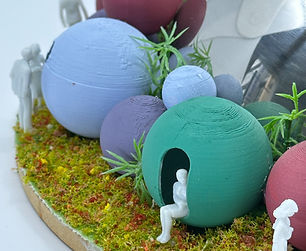
Acrylic Hemisphere, PLA Filament, Diorama Materials
Ø 29 × H 11 cm
This piece aims to investigate how individuality alters the ways we perceive architecture. It explores how people look for spaces to be alone in crowded areas. I aimed to create spaces of individuality and safety through sketching a public space with distinct spherical modular areas. I later explored the idea of safety with the bright colors we often see in our childhood, but fade as we grow older. Finally, I modeled the spheres through Autodesk Fusion, used Prusa Slicer, and printed them with gradient PLA filament. Creating a physical 3D model of this piece allowed me to develop my observations on individuality in architecture by adding transparent elements that represented the discomfort of being seen and observed. I derived ideas from the anxiety I overcame when being observed under stress during sailing competitions, being on stage, and giving speeches in MUN. While the spherical spaces symbolize the safety of being alone, the transparent dome contrasts this by showing how being observed by people makes us feel in danger. Despite this, the spherical spaces come together to create a yard where people feel comfortable through a sense of togetherness and socialization.
.jpg)
.jpg)
.jpg)
.jpg)
.jpg)
.jpg)
Mind-to-Form Architecture/Illuminating Happiness
Acrylic , Metal Hemisphere, PLA Filament, Diorama Materials
Ø 29 × H 11 cm
I iterated the element of spheres through another emotion they represented, happiness. This piece investigates the way colors and reflections are ever so slightly different and brighter when we feel joyful. I sketched and created a digital collage of this idea, focusing on how we see interconnectedness between nature and architecture when we feel joy. As the spherical elements represent how we associate spring and nature blooming with happiness, they surround a mirror dome that reflects the joy people feel. This symbolizes the spreading of happiness. I then modeled this piece on Autodesk Fusion, where I explored material usage and environment settings in 3D rendering. Through modeling this piece, I observed the relationship between color, reflection, and emotion. The piece represents happiness through an almost cloud-like structure. The space has colorful, circular elements that look bold in comparison to the dull-toned grass. The contrast between the space and the grass it is placed on shows how people are often more prone to make bold and exaggerated decisions when happy. The space is built on top of the grass that we may consider a “normal state of emotion”. The people looking inside see their happiness and the nature around them in the reflection of the dome. This draws a connection between human emotion and nature, where nature is often what we consider normal and serene in comparison to human emotion.
.jpg)
.jpg)
.jpg)
.jpg)
.jpg)
.jpg)
Mind-to-Form Architecture/Confusing and Painful Pathways
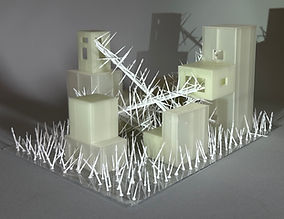
PLA Filament, Toothpick, Plastic Rod, Hot Glue
19 x 43 x 30 cm
This piece aims to explore the feeling of mental confusion and depression through brutalist architecture. I researched the ways consecutively placed square windows make me feel, and created a digital collage representing this feeling. Sketching this idea made me feel overwhelmed, and I further emphasized this feeling by adding stairways and doors on several sides of the box-like buildings I sketched. I then 3D modeled this idea on Autodesk Fusion and printed it using transparent as well as fluorescent PLA filament. Finally, I used plastic material to make paths that connected my buildings and added spikes by using plastic toothpicks. This process showed me the difficulty and importance of creating proper composition while building 3D models. Creating a physical model allowed me to experiment with the relationship between emotion, form, and light. Using a mixture of translucent and fluorescent filament embodies the way certain paths may appear clearer than others when people feel confused and depressed. As this relationship depends on the absence of a source of light, I aimed to capture the ease with which confusion can often become resolved in our minds. The toothpick spikes show a state of depression, leading to an inability to make decisions, as each decision leads to pain. The toothpicks also create an effect of horror when a light sources were added to the front, similar to the way depression makes people feel about their own minds. The idea to add spikes was inspired by the main character Esther Greenwood’s depression in The Bell Jar, leading her to become uncomfortable and pained by her own mind.




Mind-to-Form Architecture/The Nature of Optimism
This piece aims to explore excitement as an emotion and form. With the usage of different patterns and materials, I found that such patterns can represent excitement through rhythm. The inspiration for many of the elements of the piece comes from nature, whether it be leaves, the natural form of the dome-like structure, or the flower-shaped top. In addition, I used the pattern of butterfly wings as inspiration for the stained glass effect on the dome. This stained glass effect alternates colors as it goes around, resembling the colors one would imagine a butterfly wing to have.


Mind-to-Form Architecture/Circles of Anxiety
3D print, PLA
19 x 15 x 18 cm
This piece explores the feeling of anxiety through a 3D structure. I sketched, cut, and 3D printed paper strips using Autodesk Fusion and Prusa Slicer to form public displays, observing the transformation from 2D to 3D. Combining the papers through what seemed like a chaotic order resembled the way people feel when anxious. Even though there appears to be organisation, as with the papers, we often end up seeing what we are anxious about as chaotic and messy due to the stress it creates. The piece shows how people's brains tend to look for stress and anxiety even when there is organization, let alone organized chaos. Similarly, the way people perceive architecture and form tends to rely on assumptions rather than actual, in-depth observation.
While this piece investigates organised chaos, the reflections it creates replicate the feeling of anxiety. The pieces were 3D modeled through Fusion and printed with pink, blue, and translucent PLA filament. The color tones are relatively closer in the blue model and more distinct with smaller holes in the pink one, showing the differences between severe anxiety and the daily anxiety that many of us feel in exams, public speaking, etc. The pink and translucent model draws a bold contrast between what we may call the normal brain (translucent) and anxiety (pink). The blue model shows less distinction between the shades of blue, symbolizing a less harmful type of anxiety.


Toward the Third Dimension/Assemblage From 2D to 3D
Paper on Canvas
70 x 50 cm
Using the same paper cutouts I used for the sculpture representing anxiety, I made an assemblage. I observed the relationship between paper creating 3D forms and the shadows of these forms. As I stuck the paper cutouts on a canvas, I organized them in a diagonal.
.png)
.jpg)
.jpg)
.jpg)
_JPG.jpg)
Toward the Third Dimension/Where Movement Meets Form
Arduino Uno Microcontroller, Servo Motor, Fishing Lines,
Power-bank, Wooden Structure
28 x 27 x 29 cm
This project allowed me to investigate the intersection of technology and form. I turned 2D paper cutouts into 3D form by using a servo motor that rotated 180 degrees and coding through Arduino IDE. I connected the paper cutouts to the motor using a fishing line and tied the other end of the fishing line to a wooden frame. This allowed the structure to move in a smooth and natural way as I observed a form of kinetic art.
.png)
.png)
.png)
.png)
.png)
Sketching Through A Different Lens and Exploring Form
Oil-Based Charcoal on Paper
25 x 30 cm/
Ink on Paper
25 x 35 cm
The first Sketch aims to capture a project that I completed through a different lens. I drew the 3D model that I made, not from the lens of someone who made it, but from the lens of an observer. As I explored this perspective of my work, I used watercolor and ink to create a dramatic effect. The second Sketch explores a combination of geometric forms, organic forms, and the reflection of metal.
.jpg)
.jpg)
How Cities Affect Our Lives
Drawing Pencils, Ink, Oil-Based Charcoal
14.8 x 21.0 cm
My work delves into the complex emotions and consequences of living in a city. I explored feelings of nostalgia and captivity in the cities where my life revolves, New York and Istanbul. I strived to incorporate different viewpoints on cities, the overconsuming systems they rely on, and how they affect my view of what I call home through the lenses of two of my favorite books, Fahrenheit 451 and The Bell Jar. By doing so, I experimented with different materials like watercolor, charcoal, and colored pencils. All three works show a darker perspective on how we view our seemingly enchanting cities, which we desperately desire to live in.


Earthquake Resistant Modular Housing
Origami Paper, Glue
3-6 x 3-6 x 3-6 cm
This project is currently in process and aims to create modular housing prototypes to be used during the infrastructure recovery process after the 2024 earthquake in Hatay, Turkey. I strived to create alternative housing options for people who lost their homes in the earthquake. I was inspired by Turkish nomad culture, which also uses modular tents. Combining the elements that made the tents feel familiar with feasibility allowed me to create origami prototypes. These prototypes are easy to carry and are attached to one another. As I explored modularity through origami, I initially worked with paper boats and calculated their volume using Heron's formula. While this form yielded strong results, it did not appear to be practicable. This process led me to use origami in a different and feasible form for housing. I then started working with box-shaped housing of different sizes.
.jpg)
.jpg)
.jpg)
.jpg)
.jpg)
.jpg)
.jpg)
.jpg)
.jpg)
.jpg)
.jpg)
.jpg)